Preparing Your Dog For Autumn Changes

September 16, 2009

As we savor the last days of summer, we also plan for fall's changes. We take the kids shopping for back-to-school clothes and supplies. We mentaly prepare ourselves for getting back to the grind at work. But we also need to prepare our dogs.

Because come Autumn, your dog's life often changes, too. The kids go back to school and aren't around for extended playtime. Young adults leave for college and can't interact with her at all. Older adults may be preoccupied with missing the kids or getting back to work themselves. The result can be a lonely dog who barks, forgets her housetraining, becomes destructive, or simply acts depressed.

A little planning beforehand can forestall such trauma. Here's how:

  • Change caregivers. If your dog's main caregiver is a family member who soon won't be around to do that, start making the switch to an adult or sibling who will remain behind. Begin by having the primary caregiver take your dog for two walks a day, with teh new caregiver doing the rest. By the time the primary caregiver departs, the new caregiver should already have taken over.
  • Maintain routines. Although your dog's caregiver may change, her routine shouldn't. She should eat, walk, and play at the same times with her new caregiver.
  • Keep active. Trainers often say that a tired dog is a good dog - for good reason. A dog who has gotten some vigorous exercise is too pooped to get into trouble. Give your dog at least 20 minutes of aerobic activity daily, but don't do such activity in the middle of a hot day.
  • Monitor carefully. If your dog quits eating or acts lethargic as you make these adjustments, don't assume she's unhappy with what's going on. She could be physically ill. Take her to the veterinarian if such behavior continues for more than a day or two.
*Courtesy of DogFancy (Oct.2009 issue) / Written by Susan McCullough

A Weather Forecast . . . For Your Dog?

September 12, 2009

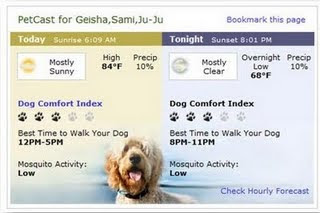
I recently read about this neat website hosted by The Weather Channel that lets you check tells you the most optimal time to walk your dog, based upon the forecast for that day, your pet's age and coat type. It also tells you the mosquito activity levels in your area, tells you the number of calories you will burn while walking your little buddy, and offers a map that tracks the local flea activity. Check it out at www.weather.com/pet
s.

Disaster Plan

September 9, 2009

So, here we go. Another hurricane season is upon us. Every hurricane season, I'm reminded of the disasterous Katrina, which unfortunately resulted in the death and displacement of many abandoned pets.

There are many kinds of disasters that can strike. Some personal tragedies / disasters require that you leave your home suddenly, resulting in the need for a pet sitter. Other disasters may require you to evacuate your home entirely. Hopefully, in instances like this, you will be able to take your animals with you. The sad truth is that you may not always be in a position to do this. In the event that a tragedy occurrs, it is best to take the Boy Scout moto and BE PREPARED. Make plans now to avoid being disorganized when the pressure is on. The advice in this blog entry will help you do just that.

DISASTER SUPPLY & CHECK LIST
Make a "Disaster Supply Corner." Dedicate a corner of your home, basement, garage, or attic, for these emergency supplies.

- Crates, cages, or containers, for evacuating every pet in your household
- Bedding for crates
- Vehicle with room for all crates, food, water, and personal gear. Responsible pet owners will always own one vehicle that is large enough for evacuating pets.
- Collapsible pen or temporary fencing
- Cat litter box and extra litter (for cat owners)
- Leashes and collars (with ownership and rabies tags) for every pet
- Toys and treats
- Water for drinking, 2 gallons for each person and pet
- Pet food (sealed for storage) in plastic bins, enough for two weeks
- Bleach (plain household) to treat drinking water (12 drops per gallon)
- Dropper to measure bleach into water
- Instructions for pet care and feeding
- Pet medications
- Veterinary records
- Photos of all pets showing identifying marks loaded to CD and printed, and vaccination forms
- List of pet-friendly lodging options and phone numbers
- First aid kit
- Flashlight and extra batteries

PET SURVIVAL PLAN
Make an Indoor/Outdoor Pet Shelter in Your Home. Turn your home into an indoor/outdoor pet shelter so that they can survive without you for at least 2 weeks.

Advance Preparations
- Microchip your pets, so they may be identified if you are separated from them.
- Make photographs of your pets for identification, including views of important identifying markings, and keep these with your important papers.
- Ask your pet sitter or a neighbor to call you immediately wherever you are, if a disaster threatens or occurs, any time of day or night.
- If you receive such a call while you are away, call your Reciprocal Foster to make pet care plans.

Before Leaving the Pets
- Remove one entrance door from its hinges (store it on the floor in a distant room) to allow at-will, safe, and permanent access to the outdoors. The door should not be exposed to prevailing winds. Yes, there are risks involved with leaving your home open. If you can, take your pets with you instead.
- Open all windows to allow air circulation in hot climates.
- Post a large sign inside a window that reads: PLEASE RESCUE OUR PETS, if you are uncertain about whether you can return within 2 weeks.
- Post a list TO RESCUERS near the inside entrance that includes: Your contact information; Your reciprocal foster contact information; All pets by name and type, and any medical needs; state that you will make attempts to find and claim your pets.
- Fill all bathtubs and sinks with clean water. Fill buckets with clean water. Fill big plastic tote bins with clean water. Distribute clean water throughout the house. In hot weather, dehydration can kill in 2 to 3 days, especially young, ill, or elderly pets!
- Treat the drinking water so that the standing water doesn't develop bacterial infestations: 16 drops of plain household chlorine bleach per gallon of water.
- Distribute all of your emergency pet food in pans, buckets, and bowls, at least a month's supply.
- Distribute pet toys and favorite beds or blankets.
- Clean all cat litter boxes and fill with litter.
- Turn furniture over that you don't want pets climbing on (list these).
- Unplug all outlets throughout the house.
- Turn off gas or heating oil connections.
- Turn off water mains to the house.

Return within 2 weeks without fail.
Your pets are your responsibility; pray that they will be alive and waiting for you.

Reality Check: This is not the time to worry about poop and pee. If your pets survive the disaster and the aftermath, be grateful.

For more resources on the topic of rescue of animals in emergencies, including preparedness information, check out this page: Emergency Animal Rescue Service (EARS


*The information provided above is courtesy of SunbearSquad.Org.
** Picture courtesy of National Geographic - Dogs awaiting rescue in Mississippi after Katrina

A Tribute on this blackest of Tuesdays

September 1, 2009

My best buddy, my black lab, BlackJacks, just passed away. Via con Dios, little buddy. You've been a constant in my life for 15 years now. I miss you so much already.

“He is my other eyes that can see above the clouds, my other ears that hear above the winds. He is the part of me that can reach out into the sea. He has told me a thousand times over that I am his reason for being; by the way he rests against my leg; by the way he thumps his tail at my smallest smile; by the way he shows his hurt when I leave without taking him. (I think it makes him sick with worry when he is not along care for me.) When I am wrong, he is delighted to forgive me. When I am angry, he clowns to make me smile. When I am happy, he is joy unbounded. When I am a fool, he ignores it. When I succeed, he brags. Without him, I am only another man. With him, I am all-powerful. He is loyalty itself. He has taught me the meaning of devotion. With him, I know a secret comfort and a private peace. He has brought me understanding where before I was ignorant. His head on my knee can heal my human hurts. His presence by my side is protection against my fears of dark and unknown things. He has promised to wait for me…whenever…wherever - in case I need him. And, I expect I will -- as I always have. He is just my dog.” - Gene Hill

FIRST AID IN THE FIELD (Entry #7 - "Making a First Aid Kit")

August 26, 2009

In order to treat field injuries, you should always be prepared with a first aid kit. It doesn't have to be a large, burdensome kit. In fact, the majority of what you need to will fit into a small Ziploc bag.

The following items are what should be included in any basic first aid kit for your pet, and will come in handy if an emergency were to arise:
  • Scissors
  • Tweezers
  • Thermometer
  • Hydrogen peroxide
  • Ophthalmic antibiotic ointment
  • Vetrap cotton bandage wrap
  • Elastic wrap, such as Elastikon or Vetrap
  • Waterproof wrap, such as Wet Pruf
  • Bottled water

Remember, it is a good idea to talk with your veterinarian to learn about the specific items and medications that will be best for your outdoor excursion.

Dog Camps in the USA

August 22, 2009

This month's issue of DogFancy contains an interesting article about summer camps that are specifically designed to accomodate families and their canine companions. The camps provide a variety of dog-friendly activities including agility, lure coursing, and dock jumping. Many camps also provide activities for humans, such as dog training and creative classes like dog treat making and spinning dog fur. Being dog camps, there are, of course, many activites a dog can do along with his human counterpart. Treasure / Scaventer Hunts, as well as Water Rescue are just two examples.

This sounds like a great idea! I had no idea these camps existed. For dog and outdoor lovers, what better way to incorporate your pooch into your vacation plans?

Here is a list of some canine camps, as provided by DogFancy:

FIRST AID IN THE FIELD (Entry #6 - "Stomach Torsion / Bloat")

August 19, 2009

Stomach Torsion, also known as Bloat, occurs when the stomach becomes twisted, causing intestinal gases to build up. The condition is very painful and can be fatal if not treated right away. It is similar to having a balloon in your dog's belly that keeps expanding. It is not entirely known what causes this condition, though suspected culprits include certain types of food large amounts of food, and/or heavy exercise. Though it is uncommon for this to occur in the field, there is still a possibility so I felt it best to discuss this in our First Aid In The Field series.

Bloat is treated by inserting a stomach tube through the throat and into the stomach to release the trapped gas. More severe cases require surgery. If your dog looks bloated, acts restless, tries to vomit unsuccessfully, has excessive salivation and has labored breathing, get him to a vet immediately. If you are in a place where a veterinarian is not available, you will need to try to relieve the pressure yourself. This can be done by inserting a large bore needle into your dog's abdomen - the area right behind the ribs while your dog is in a standing position. If possible, you really need to contact a veterinarian before trying this procedure, as it is very risky. THIS PROCEDURE SHOULD ONLY BE DONE AS A LAST RESORT TO SAVE YOUR DOG'S LIFE.

If you feel your dog may be prone to Stomach Torsion, you should take precautionary measures. Feed your dog smaller meals twice-a-day, rather than one large meal. Also, refrain from letting your dog exercise after meals. This condition typically occurs when dogs are overly excited, not eating regularly, or are out of their normal circumstances.

Tax Deductible Pet Care Expenses

August 17, 2009

Congressman Thaddeus McCotter of Michigan (http://mccotter.house.gov/HoR/MI11/Home/) has introduced a new act called the HAPPY Act - The Humanity and Pets Partnered Through The Years act (http://thomas.loc.gov/cgi-bin/query/z?c111:H.R.3501).

Based on the fact that more than 60% of households have pets, and because those pets contribute to our well-being, this bill, if passed, would allow pet owners to take a tax decuctible for up to $3500 in pet care expenses. The wording on the bill states that…

qualified pet care expenses means amounts paid in connection with providing care (including veterinary care) for a qualified pet other than any expense in connection with the acquisition of the qualified pet.

The Pet Industry Joint Advisory Council (http://www.pijac.org/_documents/us_hr_3501_happy_act.pdf) is asking people to contact their representative and encourage them to consider the bill favorably. See their website to read more, including information on how to contact your representative.


Thanks to PetSit USA for providing the above information.

CARING FOR YOUR SENIOR (Entry #2 - "Doggie Dementia")

August 15, 2009

A dog is considered to be a senior citizen at age 7. And just like senior humans, senior dogs can start having mental "slips" as they get older. This is known as Doggie Dementia. Here are some signs to watch for:
  • Changes in sleeping-waking patterns
  • Aimless wandering, pacing or circling
  • Uncharacteristic house soiling
  • Changes in relationships with family
  • Whining or inappropriate barking
  • Getting lost in familiar surroundings
  • Unresponsiveness to known commands
  • Unusual restlessness
  • Uncharacteristic anxiety (separation anxiety, fearfulness)

Evidence of this cognitive dysfunction syndrome is made by process of elimination by your veterinarian, as it is impossible to test directly for this condition except by autopsy of the brain. Your vet may first test for blindness, urinary tract infection, or kidney disease in this elimination process.

If your vet does determine that your dog suffers from Doggie Dementia, he may prescribe Anipryl, which can help reduce the symptoms. However, there are some things you can do at home to reduce the symptoms, as well. Dogs who suffer from dementia do best when you follow a strict routine and provide regular age-appropriate exercise. Antioxidants, nutrient-rich food, and supplements & nutraceuticals can also benefit seniors. But most importantly, keep your dog involved in life.

TEACHING BASIC COMMANDS – ENTRY #8 ("WATCH ME")

August 12, 2009

If you don't have your dog's attention, it is impossible to give him commands he already knows, nor will you be able to teach him new commands. This is why it is important to teach your dog the command "Watch Me". In a location with many distractions, this command definitely comes in handy. To teach your dog this command, simply follow these easy steps:
  • When your dog is looking elsewhere, say your dog's name followed by the words "WATCH ME".

  • When he looks at you, reward him with a treat.

  • Gradually increase the time by withholding the treat for several seconds.

  • Practice this command often - every time you want to get your dog's attention.

Some dogs are a little easier to teach this command than others. For those four-legged friends that don't quite understand, try using the following method:

  • Say your dog's name while, at the same time, holding a treat in front of his nose.

  • Slowly move the treat from the front of your dog's nose to your face while saying the words "WATCH ME".

  • Hold the treat between your eyes for several seconds.

  • Reward him with the treat.

  • Once your dog is consistently following the treat, try luring him without the treat using the method previously discussed.

Once your dog understands this command, it will be easier for you to start working with him to carry out your commands in more public areas.